
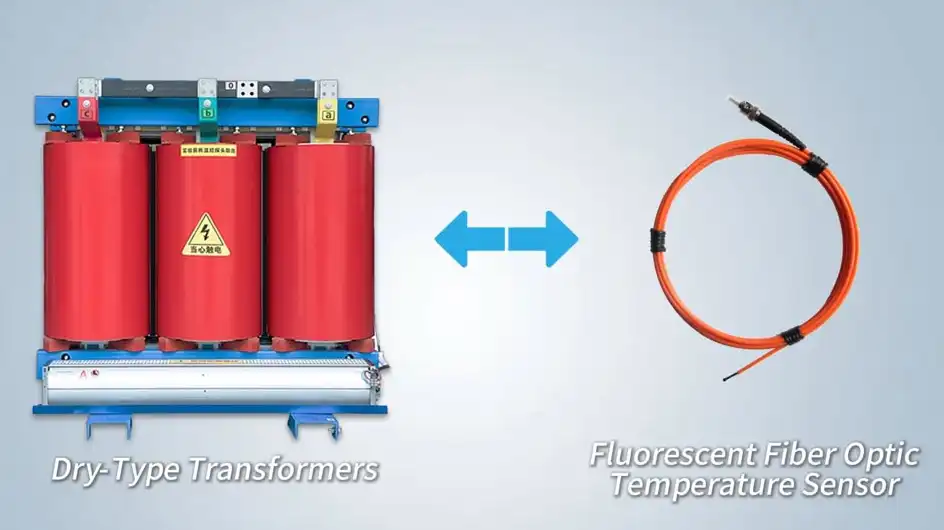
Oil-immersed and dry-type transformers do not use exactly the same temperature measurement approach because their insulation, cooling and winding structures are different.
Oil-immersed transformers typically monitor temperatures such as top-oil temperature and winding or winding hot-spot temperature. Winding temperature may be estimated through a winding temperature indicator or thermal model, or measured directly at selected internal points using embedded fiber optic temperature probes. Dry-type transformers do not use insulating oil, so temperature monitoring focuses primarily on winding, coil, core or other selected equipment temperatures. PT100 / RTD sensors are commonly used in dry-type transformer temperature control systems, while fiber optic temperature sensors can be used where direct optical sensing, electrical isolation or high-voltage / EMI immunity is required.
In short: oil-immersed transformers need to monitor both the oil and the winding thermal condition, while dry-type transformers focus mainly on winding and coil temperatures because no insulating oil is present. The correct method depends on what actually needs to be measured - oil temperature, average winding temperature, estimated hot spot, or actual temperature at a selected physical winding point.
Key Takeaways
- Oil-immersed transformers monitor both oil and winding thermal conditions.
- Dry-type transformers primarily monitor winding or coil temperatures.
- A winding temperature indicator commonly represents calculated or simulated winding temperature rather than direct conductor temperature.
- Embedded fiber optic probes can directly measure selected internal winding points.
- PT100 / RTD sensors are widely used in dry-type transformer temperature control.
- Sensor quantity and monitoring channels should follow the actual number of measurement points.
What Temperatures Are Measured in an Oil-Immersed Transformer?
An oil-immersed transformer commonly monitors top-oil temperature, selected oil temperatures where required, winding temperature, winding hot-spot temperature, and direct internal winding temperature where embedded sensors are used.
Oil temperature is not the same as winding temperature. The winding conductor can operate at a different temperature from the surrounding oil, depending on load, cooling and winding design, so both quantities are typically tracked separately rather than treated as one value.
What Temperatures Are Measured in a Dry-Type Transformer?
Dry-type transformers do not contain insulating oil, so monitoring focuses on winding temperature, coil temperature, phase winding temperature, and selected core or structural temperatures where required.
These transformers typically use PT100 / RTD sensors connected to a dry-type transformer temperature controller. Fiber optic probes can also be used for selected direct winding measurement points, though not every dry-type transformer installation requires them.
Oil-Immersed vs Dry-Type Transformer Temperature Measurement at a Glance
| Item | Oil-Immersed Transformer | Dry-Type Transformer |
|---|---|---|
| Primary Cooling Medium | Oil / oil and external cooling system | Air / natural or forced air depending on design |
| Main Temperature Targets | Oil and winding | Primarily winding / coil |
| Oil Temperature Measurement | Yes | Not applicable |
| Common Winding Measurement | WTI / thermal estimation / direct sensors | PT100 / RTD / direct sensors |
| Direct Internal Measurement | Embedded fiber optic probes possible | Fiber optic / RTD depending on design |
| Typical Controller | Transformer monitoring instrument / WTI / OTI | Dry-type temperature controller |
| Sensor Installation | Often planned during transformer manufacturing | Depends on winding / coil and controller design |
| Multi-Point Monitoring | Available | Available |
Actual sensor arrangements depend on transformer design and monitoring objectives.
How Is Oil Temperature Measured in an Oil-Immersed Transformer?
Top-oil temperature is commonly measured using a temperature sensor or oil temperature indicator positioned to represent oil temperature near the upper part of the transformer. This value can be used for temperature indication, alarms, cooling control and general transformer monitoring.
Oil temperature does not directly equal the hottest winding conductor temperature. It provides useful information about the overall thermal condition of the transformer, but winding temperature must be assessed separately.
How Is Winding Temperature Measured in an Oil-Immersed Transformer?
Oil-immersed transformer winding temperature is generally addressed through one of three approaches:
Winding temperature indicator. A WTI generally estimates or simulates winding temperature using oil temperature plus load-current-related heating compensation, depending on the instrument design. It does not directly measure the winding conductor.
Thermal model. Based on load, oil temperature and transformer thermal characteristics, a thermal model is used to produce an estimated winding or hot-spot temperature value.
Embedded fiber optic temperature sensor. An embedded probe directly measures the actual temperature at the selected physical winding point, rather than an estimated or simulated value.
How Is Winding Temperature Measured in a Dry-Type Transformer?
PT100 / RTD sensors are commonly placed at selected winding or coil locations and connected to a temperature controller. Depending on the model, the controller may be used for display, alarm, fan control, trip output or communication.
Fiber optic probes can be used for direct winding sensing, high-voltage locations, strong electromagnetic field environments, or applications where electrically isolated measurement is preferred. PT100 remains a practical, mature and widely used option for many conventional dry-type transformer installations.
WTI vs PT100 vs Fiber Optic Temperature Sensor
| Method | Typical Application | What It Measures | Main Characteristic |
|---|---|---|---|
| WTI | Oil-immersed transformer | Estimated / simulated winding temperature | Useful for conventional transformer thermal monitoring |
| PT100 / RTD | Dry-type transformers and accessible temperature points | Temperature at sensor location | Mature electrical temperature sensor |
| Fiber Optic Probe | Oil-immersed or dry-type winding applications | Actual temperature at selected physical sensing point | Electrical isolation and EMI immunity |
Direct Winding Temperature Measurement vs Temperature Estimation
Direct measurement means the sensor is physically located at a selected winding point. Estimated temperature is derived from oil temperature, load current, a thermal model, and other transformer parameters rather than a direct physical reading.
| Measurement Type | Result | Typical Method |
|---|---|---|
| Direct Point Temperature | Actual temperature at selected point | Fiber optic probe / suitable embedded sensor |
| Estimated Winding Temperature | Calculated thermal value | WTI / thermal model |
| Average Winding Temperature | Average winding thermal result | Resistance method |
A direct sensor still measures only the selected physical point, not every point in the winding. It should not be interpreted as an automatic reading of the absolute hottest location in the transformer.
How Does Sensor Placement Differ?
In oil-immersed transformers, sensor placement may involve selected winding hot-spot regions, embedded internal winding locations, oil measurement positions, and routing toward a feedthrough. In dry-type transformers, placement may involve a phase winding, a coil, a selected winding surface or internal point, and the sensor locations required by the temperature controller.
Neither transformer type uses one fixed installation position for every design - placement should follow the specific winding and cooling structure. More detail on how these locations are typically selected is covered in a companion article on fiber optic sensor placement in transformer windings.
How Does Sensor Installation Differ?
For oil-immersed transformers, embedded winding fiber optic probes usually need to be planned during manufacturing or winding assembly, since internal access becomes very limited once the winding and tank are completed.
For dry-type transformers, sensor arrangement may also be integrated during manufacturing, while some accessible sensor positions can be easier to service depending on the transformer design. In both cases, internal embedded measurement should be planned before final assembly rather than added afterward.
How Many Temperature Sensors Are Typically Used?
The number of sensors depends on transformer type, number of phases, windings monitored, measurement heights, hot-spot locations of interest, and the overall monitoring objective.
Oil-immersed transformer fiber optic systems often use 6, 8, 9, 12 or 16 channels as common configuration patterns. Dry-type transformer fiber optic temperature controllers commonly use 3, 4, 6 or 7 channels. These are common configuration patterns, not mandatory industry standards - the actual sensor count should match the actual measurement points defined for the specific transformer.
How Does Multi-Channel Temperature Monitoring Differ?
In oil-immersed transformers, multi-channel monitoring may cover several winding locations, phases, HV / LV winding sections, and different winding heights. In dry-type transformers, multi-channel monitoring may cover three phases, multiple winding points, and additional equipment temperature points.
In both cases, one point fiber optic probe normally uses one measurement channel. A separate article discusses how to determine the required channel count for a fiber optic temperature monitoring system.
How Does Fiber Length Differ Between the Two Transformer Types?
In oil-immersed transformers, the fiber may follow a longer internal route - from the winding, through internal routing, to a feedthrough, and then to the external instrument. In dry-type transformers, the monitoring controller is often positioned closer to the winding or coil, depending on the design, though this is not the case for every installation.
For many transformer applications, 3-5 m is a practical starting reference for fiber length, and typical fiber optic probe configurations support approximately 0-20 m depending on probe structure and project requirements. This is a routing consideration rather than a fixed rule tied to transformer type, and it is covered in more detail in a dedicated guide on choosing fiber length for a fiber optic temperature sensor.
How Do Alarm and Control Functions Differ?
Oil-immersed transformer monitoring may interact with cooling fans, oil pumps, alarms, transformer monitoring systems, and PLC / SCADA integration. Dry-type controllers may manage temperature display, fan control, alarm output, trip functions and communication.
Available functions depend on the selected monitoring instrument or controller rather than the transformer type itself. Depending on the product, interfaces may include RS485, Modbus RTU, analog outputs or alarm relays.
When Is Fiber Optic Temperature Measurement Useful?
In oil-immersed transformers, fiber optic sensing is useful for direct winding hot-spot measurement, embedded winding sensing, high-voltage environments, and multi-point internal monitoring. In dry-type transformers, it is useful for direct winding sensing, electrical isolation, high-voltage winding locations, strong electromagnetic field environments, and special monitoring requirements.
Fiber optic sensors complement rather than automatically replace every conventional transformer temperature sensor. The choice depends on what the monitoring objective actually requires.
Which Temperature Measurement Method Should You Choose?
If oil temperature is needed, an appropriate oil temperature measurement method should be used. If a conventional estimated winding temperature is sufficient, a WTI or thermal model may be suitable. If actual temperature at a selected internal winding point is needed, embedded fiber optic sensing may be appropriate.
For conventional dry-type transformer winding control, PT100 / RTD with a temperature controller is common. Where electrical isolation or direct optical measurement is required, fiber optic temperature sensing can be considered alongside or instead of conventional sensors.
Oil-Immersed vs Dry-Type Transformer Temperature Monitoring by Application
| Requirement | Oil-Immersed Transformer | Dry-Type Transformer |
|---|---|---|
| Oil Temperature | Important | Not applicable |
| Winding Temperature | Important | Primary monitoring target |
| Estimated Hot Spot | Commonly possible through WTI / model | Depends on monitoring design |
| Direct Winding Point Measurement | Embedded optical probe | Optical or suitable contact sensor |
| Common Conventional Sensor | Oil indicator / WTI | PT100 / RTD |
| Fiber Optic Measurement | Useful for direct internal points | Useful for isolated winding measurement |
| Multi-Channel Monitoring | Yes | Yes |
What Information Is Needed to Select a Transformer Temperature Monitoring Method?
- Transformer type
- Oil-immersed or dry-type
- Transformer rating
- Number of phases
- Winding structure
- Temperature points to be measured
- Oil temperature requirement
- Winding temperature requirement
- Direct or estimated measurement
- Number of sensing points
- Fiber length
- Required channels
- Monitoring instrument location
- Required alarm functions
- Required communication interface
- PLC / SCADA integration requirement
Common Transformer Temperature Measurement Misunderstandings
Oil temperature and winding temperature are the same. They represent different thermal locations, and the winding conductor can differ from the surrounding oil temperature.
WTI directly measures the winding conductor. A WTI commonly represents simulated or estimated winding temperature depending on its design, not a direct conductor reading.
Dry-type transformers only use one temperature sensor. Sensor quantity depends on the number of phases and the measurement points required.
A fiber optic probe measures the whole winding. One point probe measures one defined physical location, not the entire winding.
Oil-immersed and dry-type transformers use the same sensor arrangement. Their cooling, insulation and measurement objectives differ, so the sensor arrangement differs accordingly.