
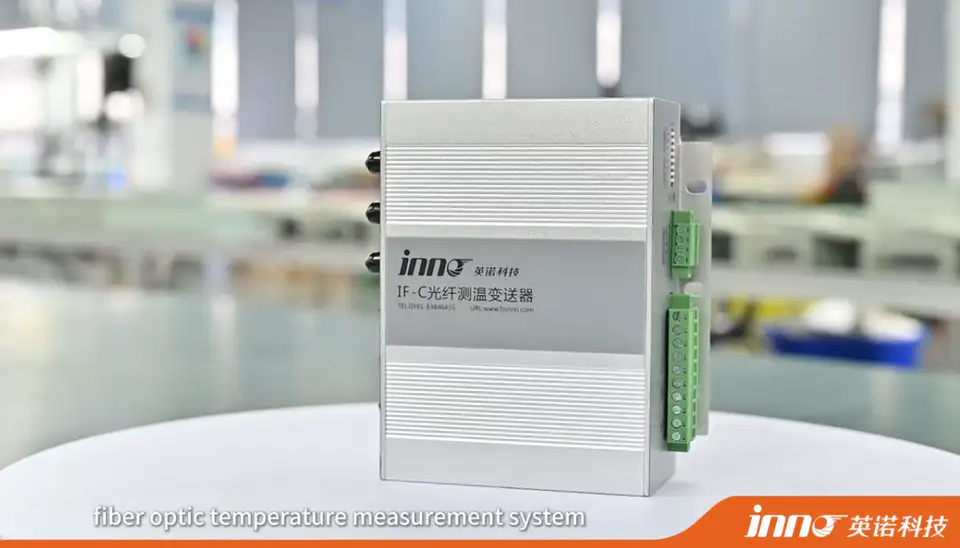
Temperature can be measured in electrically isolated environments by using a sensing method that prevents the measurement point from creating an unwanted conductive electrical path to the monitoring instrument. Common approaches include fiber optic temperature sensors, non-contact infrared measurement, and conventional electrical sensors combined with suitable isolation, signal conditioning or isolated transmitters.
For applications where the sensing point itself must remain electrically isolated from the instrument, a fiber optic temperature probe provides a particularly direct solution because the temperature signal is transmitted optically rather than through conductive measurement wiring. This guide focuses on fluorescence-based point fiber optic temperature sensing, where one probe measures one defined temperature point and no conductive electrical measurement signal travels through the fiber.
Electrical isolation does not mean the equipment has no voltage, that the whole installation is completely electrically disconnected, or that all electrical risks disappear. It means the temperature measurement path is designed to avoid unwanted electrical conduction between the sensing point and the measurement electronics.
Key Takeaways
- Electrical isolation prevents the temperature measurement path from creating an unwanted conductive connection between the sensing point and the instrument.
- Fiber optic temperature probes provide an optical, non-conductive sensing path.
- PT100 and thermocouples can also be used where suitable electrical isolation and signal conditioning are provided.
- Infrared measurement provides non-contact sensing but requires optical access to the target.
- The required isolation method depends on the electrical potential, measurement location and monitoring objective.
- One point fiber optic probe measures one defined physical temperature location.
What Does Electrically Isolated Temperature Measurement Mean?
Electrical isolation in temperature measurement means preventing an unwanted conductive electrical connection between the measurement point and the measurement electronics or acquisition system. Isolation can be applied at several places, including the sensor-to-instrument path, a transmitter input or output, an acquisition channel, a power supply, or a communication interface. This article focuses primarily on measurement-path isolation.
Galvanic isolation and an optical sensing path are related but not identical concepts. A conventional electrical sensor can still be part of an electrically isolated system if suitable isolation electronics are used further along the signal chain.
Why Is Electrical Isolation Needed in Temperature Measurement?
Electrical isolation becomes relevant where there are large potential differences, energized equipment, grounding differences, ground-loop concerns, strong electrical fields, conductive sensor wiring restrictions, or measurement electronics located at a different electrical potential from the sensing point.
Not every temperature measurement requires electrical isolation. It becomes a requirement only when the measurement environment or system architecture calls for it.
What Temperature Measurement Methods Provide Electrical Isolation?
| Method | Sensor Signal | Isolation Approach | Best Suited For |
|---|---|---|---|
| Fiber Optic Temperature Sensor | Optical signal | Non-conductive optical sensing path | Direct point measurement where sensor-level isolation is required |
| PT100 / RTD with Isolated Electronics | Electrical resistance | Electrical isolation at transmitter / acquisition system | Conventional industrial temperature measurement |
| Thermocouple with Isolated Input | Millivolt electrical signal | Isolated signal conditioning | Industrial process measurement |
| Infrared Sensor | Optical, non-contact | No physical sensor connection to target | Accessible surfaces |
Fiber Optic Temperature Measurement for Electrical Isolation
Fiber optic temperature sensing removes conductive electrical measurement wiring from the sensor signal path. The probe tip is placed at the selected point, temperature changes the optical response of the sensing material, the optical signal travels through the fiber, and the monitoring instrument calculates the temperature.
This is direct point measurement. It is not non-contact measurement, and it is not whole-area measurement - the probe reports the temperature at the specific location where it is installed.
Can PT100 Sensors Be Used for Electrically Isolated Temperature Measurement?
Yes. PT100 / RTD sensors are electrical resistance sensors, and system-level isolation can be achieved using an isolated transmitter, an isolated input module, appropriate insulation, suitable wiring, and shielding or grounding where required.
PT100 remains practical for many conventional systems. Where the sensor lead itself must not form a conductive path to the measurement point, fiber optic sensing may be more appropriate.
Can Thermocouples Be Electrically Isolated?
Yes, depending on installation and signal-conditioning design. A thermocouple uses a small electrical voltage signal, and isolation can be implemented using an insulated junction, an isolated amplifier, an isolated transmitter or an isolated acquisition channel.
The conductive leads themselves still exist between the sensing point and the electronics. This is why sensor-level optical isolation and system-level electrical isolation are different concepts, even though both can be described as "isolated" measurement.
Fiber Optic vs PT100 vs Thermocouple vs Infrared
| Method | Contact Type | Signal Path | Electrical Isolation | Main Limitation |
|---|---|---|---|---|
| Fiber Optic | Contact / embedded | Optical | Non-conductive optical sensing path | Requires probe access |
| PT100 | Contact | Electrical | Depends on system design | Conductive leads |
| Thermocouple | Contact | Electrical | Depends on isolation design | Conductive leads |
| Infrared | Non-contact | Optical | No electrical contact with target | Requires line of sight |
Sensor-Level Isolation vs Instrument-Level Isolation
Sensor-level isolation means there is no conductive measurement wiring from the sensing point - a fiber optic temperature probe is a typical example. Instrument-level isolation means electrical sensor wiring exists at the measurement point, but isolated electronics separate that input from the downstream system, as with an isolated RTD transmitter or an isolated thermocouple module.
These two approaches solve different electrical isolation requirements, and the right choice depends on where in the measurement chain isolation is actually needed.
Electrically Isolated Temperature Measurement in Transformers
Transformers can require direct winding temperature measurement at a high electrical potential, internal sensing point. A fiber optic probe can be embedded at a selected winding location during manufacturing, providing an electrically isolated sensing path to that point. Detailed placement logic for this application is covered in a related article on how transformer winding temperature is measured.
Electrical Isolation in High-Voltage Equipment Temperature Measurement
In switchgear, busbars, cable terminations, energized conductors and electrical test equipment, the measurement point may operate at a different electrical potential from the monitoring instrument. Optical sensing avoids a conductive temperature-signal path between these two locations. This is one of the main reasons fiber optic sensing is used for high-voltage temperature measurement.
Power Electronics, IGBT and SiC Temperature Measurement
Power electronics testing can involve high switching voltage, fast transients, strong EMI and floating electrical potentials. Isolated temperature measurement can be applied at a module surface, device package, selected thermal point or test fixture.
Measurement should be described as the temperature at the probe's physical location rather than as a direct junction temperature, unless the sensor installation specifically corresponds to that measurement point.
RF and Microwave Temperature Measurement
Conductive temperature sensors may interact with RF or microwave environments depending on configuration. A fiber optic probe provides a non-conductive sensing path and can be used in microwave heating, RF test systems, dielectric heating and industrial microwave equipment.
Temperature Measurement in Strong Magnetic Fields and MRI Systems
In strong magnetic field environments, electrical and metallic sensing arrangements may require special consideration. Fiber optic sensing offers an electrically isolated, optical signal path that can be suitable for selected temperature measurement points in strong magnetic environments.
Compatibility with a specific MRI or magnetic-field system should be confirmed against probe materials, instrument placement and the equipment manufacturer's requirements rather than assumed from a general field-strength value.
Electrically Isolated Temperature Measurement in High-Voltage Test Laboratories
In a test laboratory, the test object and the monitoring instrument can be physically separated, with fiber length supporting remote instrument placement. This applies to dielectric testing, insulation testing, electrical equipment test benches and high-voltage research, where actual safe distances and test voltage procedures should follow the applicable facility standards.
When Is Non-Contact Infrared Measurement a Better Fit?
Infrared measurement is well suited to accessible surfaces, visible targets, temporary inspection and situations where probe installation is not practical. Fiber optic sensing is typically considered for internal point measurement, embedded measurement, continuous contact measurement and enclosed locations where probe access is available.
How Does EMI Relate to Electrical Isolation?
Electrical isolation and EMI immunity are related benefits in some applications, but they are not the same concept. Electrical isolation prevents unwanted conductive electrical connection, while EMI immunity describes the resistance of the measurement path to electromagnetic interference. Fiber optic sensing can provide both advantages along the optical sensing path, but they should not be treated as a single concept.
Can Multiple Electrically Isolated Temperature Points Be Monitored?
Yes. One point probe normally uses one measurement channel, and a multi-channel system can monitor multiple transformer winding points, switchgear connections, test objects, power electronics locations or laboratory equipment.
For special projects, approximately 1-64 channels may be configurable depending on the monitoring instrument and project requirements, though not every product supports this full range. Channel planning is discussed further in a related article on how many channels are needed for fiber optic temperature monitoring.
How Far Can the Sensor Be from the Monitoring Instrument?
Fiber length is a routing parameter, not a temperature range parameter. Typical INNO point-probe configurations support approximately 0-20 m depending on probe structure and project requirements, while 3-5 m is a practical initial reference for many equipment applications. The actual length should follow the real routing path, instrument position, feedthrough location and installation allowance, as described in a dedicated guide on choosing the right fiber length for a fiber optic temperature sensor.
Does Electrical Isolation Affect Temperature Accuracy?
Electrical isolation itself does not automatically make a temperature sensor more accurate. Accuracy depends on sensor technology, probe design, the sensing element, the monitoring instrument, thermal contact, system configuration and application conditions.
The isolation advantage of fiber optic sensors mainly addresses the electrical measurement environment, not a guarantee of higher accuracy.
How to Choose an Electrically Isolated Temperature Measurement Method
If direct contact measurement is needed with no conductive measurement path, fiber optic temperature sensing is a suitable direction. If conventional electrical sensing is acceptable but downstream isolation is needed, PT100 / RTD with an isolated transmitter can work. If wide industrial process compatibility is needed, a thermocouple with an isolated input is common. If only accessible surface temperature is required, infrared measurement is appropriate. For multiple isolated points, a multi-channel fiber optic system or a suitable isolated acquisition system can be used.
Electrically Isolated Temperature Measurement Selection Guide
| Requirement | Practical Direction |
|---|---|
| No conductive signal path at measurement point | Fiber optic temperature sensor |
| Conventional RTD measurement with isolated output | PT100 + isolated transmitter |
| Thermocouple process measurement with isolation | Thermocouple + isolated acquisition |
| Accessible surface only | Infrared measurement |
| Internal high-potential point | Fiber optic probe where installation permits |
| Strong RF / microwave environment | Fiber optic sensing may be suitable |
| Multi-point isolated sensing | Multi-channel fiber optic monitoring system |
Final selection depends on the equipment design and required level of electrical isolation.
What Information Is Needed Before Selecting an Isolated Temperature Sensor?
- Equipment type
- Measurement point
- Electrical potential at the sensing location
- Required type of electrical isolation
- Contact or non-contact measurement
- Internal or surface temperature
- Required temperature range
- Expected operating temperature
- Probe dimensions
- Fiber or cable length
- Number of measurement points
- Number of channels
- Monitoring instrument location
- EMI / RF / magnetic environment
- Required communication interface
- Alarm output requirement
- PLC / SCADA requirement
- Installation space
Common Electrically Isolated Temperature Measurement Misunderstandings
Electrical isolation means no voltage is present. This is incorrect. Isolation refers to separation in the measurement path, not the absence of voltage.
Only fiber optic sensors can be used in isolated systems. This is incorrect. PT100 and thermocouple systems can use isolated transmitters or acquisition modules.
An isolated transmitter makes the sensor wiring non-conductive. This is incorrect. The sensor leads remain conductive; isolation occurs at the electronics.
Fiber optic temperature sensing is always more accurate. This is incorrect. Its key benefits are optical isolation and EMI immunity, not automatically higher accuracy.
Infrared and fiber optic temperature sensors perform the same measurement. This is incorrect. Infrared is normally non-contact surface measurement, while fiber optic probes provide direct point sensing where the probe is positioned.